Storing your lawn mower properly in the garage isn’t just about finding an empty corner – it’s about protecting your investment while maximizing your space. With the right storage approach, you can extend your mower’s lifespan, prevent costly repairs, and keep your garage organized year-round.
Whether you’re dealing with a push mower, riding mower, or electric model, this comprehensive guide on how to store a lawn mower in the garage will walk you through everything you need to know about safe and efficient storage (+15 ideas).
From essential preparation steps to space-saving solutions, you’ll discover practical strategies that work for any garage size or layout.
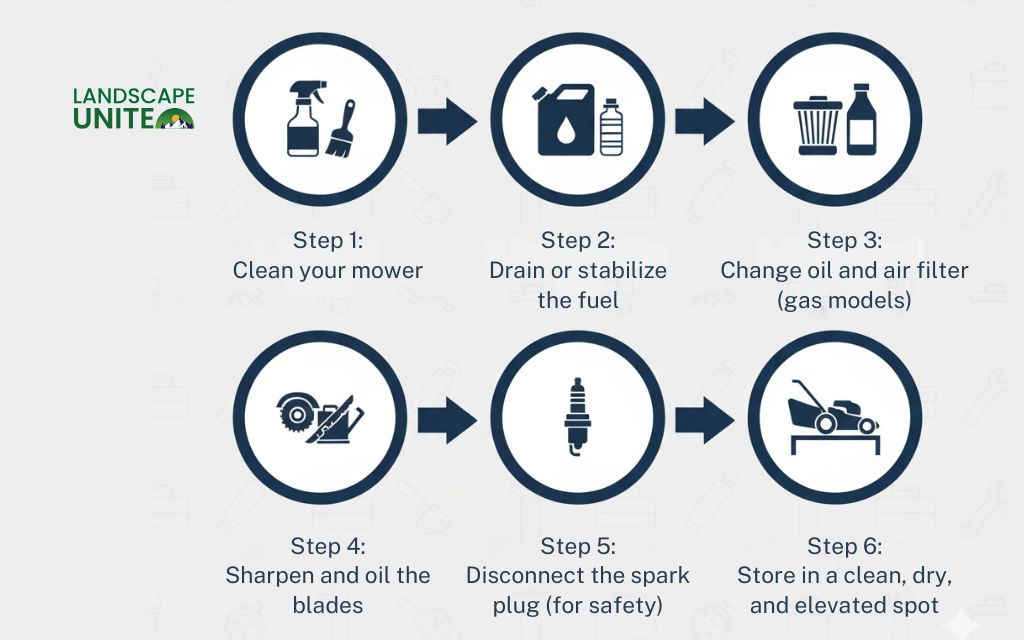
How to store a lawn mower in the garage
Before you roll your mower into its storage spot, proper preparation is essential. These 6 fundamental steps ensure your equipment stays protected from rust, corrosion, and mechanical issues during storage periods.
Step 1: Clean your mower thoroughly
Start by removing all grass clippings, dirt, and debris from every surface of your mower. This leftover organic material traps moisture against metal surfaces, accelerating rust and corrosion. Pay attention to the undercarriage and around the blade housing where buildup accumulates most.
For stubborn debris, a garden hose works well for most cleaning tasks, but avoids spraying water directly into the engine, air filter, or electrical components.
An air compressor is even better, as it removes debris without introducing moisture. Allow your mower to dry completely before moving to the next step. This usually takes 30 – 60 minutes in a well-ventilated area.
Step 2: Drain or stabilize the fuel
Fuel management is critical for gas-powered mowers. Gasoline begins degrading after just 30 days, forming varnish and gum deposits that clog carburetors and fuel lines.
You have 2 options: run the engine until it’s completely dry, or add a fuel stabilizer.
If you’re storing your mower for more than a month, adding fuel stabilizer is the recommended approach. Pour the stabilizer into your fuel tank according to the product instructions (typically 1 ounce per 2.5 gallons), then run the engine for 5-10 minutes to circulate the treated fuel throughout the system. This method is important for winter storage when your mower will sit unused for several months.
For battery-powered electric mowers, remove the battery and store it indoors at room temperature. Extreme cold or heat degrades battery cells and reduces their lifespan. Check the manufacturer’s guidance on whether to store it fully charged or at 50% capacity.
Step 3: Change oil and air filter (gas models)
Old oil contains contaminants, moisture, and combustion byproducts that can corrode engine components during extended storage. Changing the oil before storage ensures your engine has clean lubrication protecting its internal parts. This maintenance task takes about 15 minutes and significantly extends engine life.
Warm up your engine briefly to help the oil flow more easily, then drain the old oil into a container for recycling. Replace it with fresh oil according to your owner’s manual specifications.
Remember to inspect the air filter. If it’s dirty or clogged, clean it if it’s foam-type or replace it if it’s paper. A clean air filter prevents contaminants from entering the engine and ensures easy starting when you retrieve your mower from storage.
Step 4: Sharpen and oil the blades
Before storage, remove the blade (always disconnect the spark plug first for safety) and sharpen it with a file or grinder to restore a clean cutting edge. A sharp blade requires less engine power and delivers better results.
After sharpening, apply a light coating of machine oil, WD-40, or similar rust preventative to all metal surfaces of the blade.
This protective layer prevents oxidation during storage, especially important in humid climates or if you’re storing your mower directly on concrete. Don’t forget to coat other exposed metal parts like height adjustment mechanisms and wheel axles.
Step 5: Disconnect the spark plug (for safety)
This simple safety step takes 5 seconds but prevents potentially dangerous accidents.
Disconnecting the spark plug wire ensures your mower cannot accidentally start while you’re performing maintenance, moving it into storage, or working around it in your garage. This is important if you have children who might be curious about garage equipment.
For added protection during long-term storage, remove the spark plug completely, add a tablespoon of oil into the cylinder, and pull the starter cord a few times to distribute the oil. This prevents cylinder walls from rusting.
Replace the spark plug loosely to keep debris out of the cylinder.
Step 6: Store in a clean, dry, and elevated spot
Location matters when storing your mower. Damp concrete floors transfer moisture to metal components, promoting rust even on well-maintained equipment.
Elevate your mower using wooden pallets, plastic platforms, rubber mats, or dedicated storage stands to create an air gap between your mower and the floor.
Choose a spot away from your garage door where temperature fluctuations and moisture intrusion are minimized. If possible, position your mower near a wall where you can utilize vertical storage accessories.
Ensure adequate clearance around the mower for air circulation – stagnant air in enclosed spaces promotes condensation and musty odors.
15 smart lawn mower storage ideas for your garage
Now that your mower is properly prepared, it’s time to find the perfect storage solution. These 15 creative ideas help you maximize every square foot of your garage and keep your equipment accessible and protected.
Use a wall-mounted mower hanger
Wall-mounted hangers are game-changers for small garages where floor space is precious.
Heavy-duty brackets designed for push mowers can support 50-100 pounds and lift your mower completely off the floor. These systems mount to wall studs and feature padded or rubberized contact points to protect your mower’s frame.
Installation takes about 30 minutes and requires only basic tools. Mount the hanger at a comfortable height – typically 12-18 inches off the floor – making it easy to lift and hang your mower after each use.
This solution is ideal for lightweight push mowers and electric models.
Install ceiling storage racks
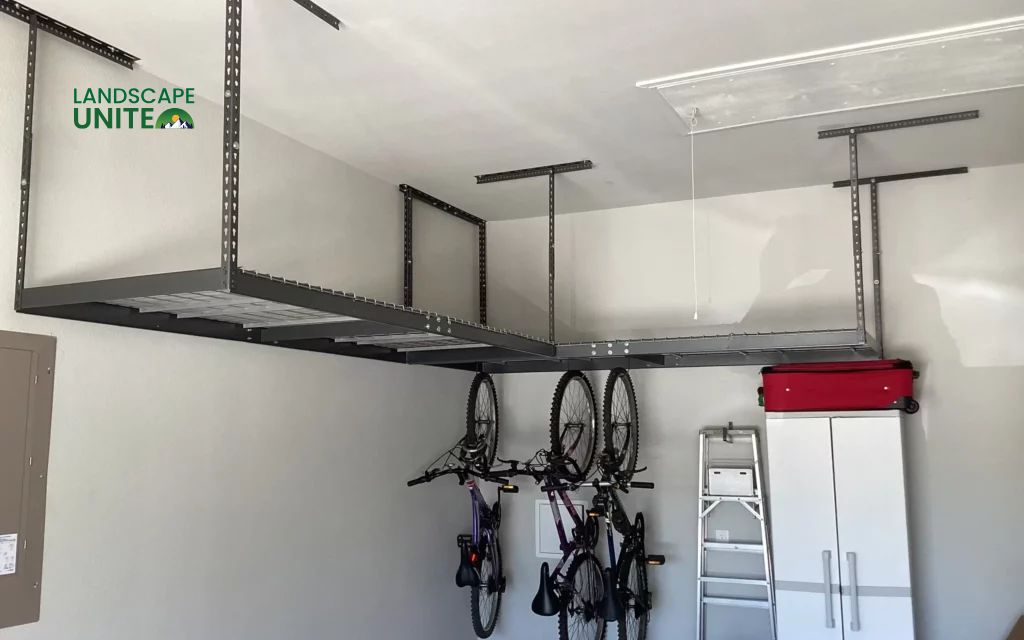
For garages with limited wall space, ceiling storage opens up an entirely new dimension.
Overhead racks with pulley systems or fixed platforms can accommodate foldable electric mowers or smaller push mowers, keeping them completely out of your working area. This approach is effective if you have 8-foot or higher ceilings.
Ensure your ceiling rack is rated for at least 50-75 pounds to safely support your mower plus a safety margin. Pulley-based systems make lifting and lowering easier, while fixed platforms work well if you don’t need frequent access.
Always secure ceiling racks to ceiling joists, never just to drywall, and test the system with weight before trusting it with your expensive equipment.
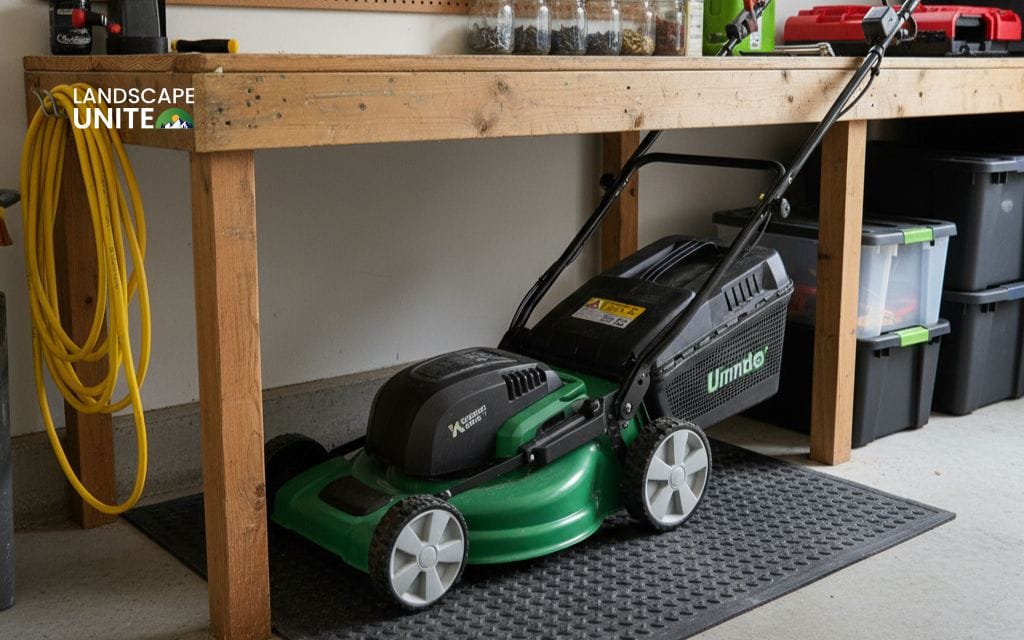
Park under a workbench
If you have a workbench along one wall, the space underneath is prime real estate for compact mower storage. This location keeps your mower protected from accidental bumps while maintaining easy access.
This solution works best with push mowers that are 20-22 inches tall or electric models with foldable handles.
Add a drip tray or moisture-resistant mat under the mower to protect your workbench area from oil drips or tracked-in moisture. Consider adding casters to your mower for easier sliding in and out of this space.
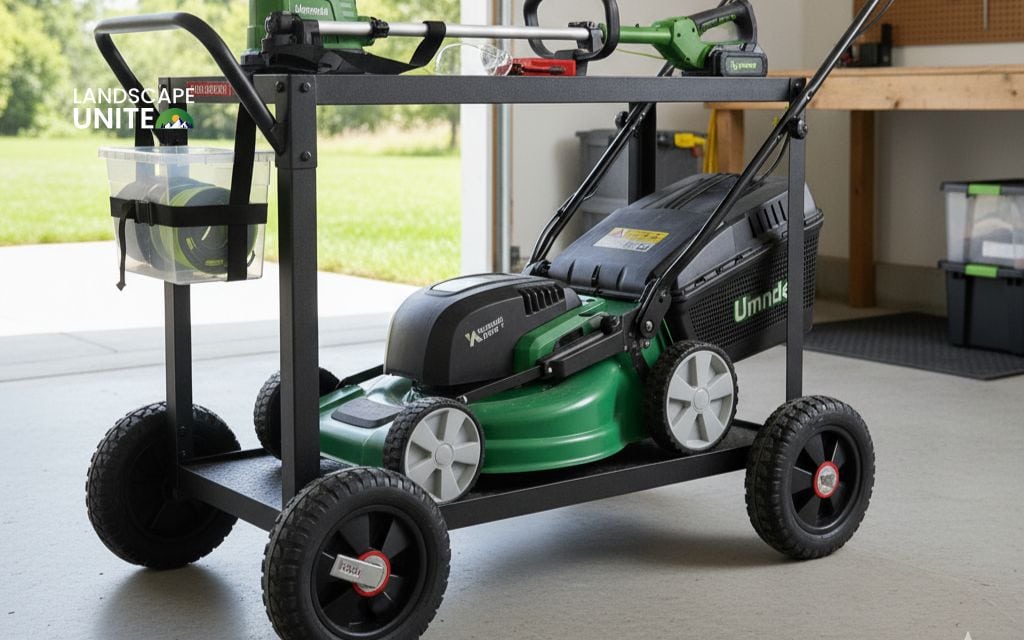
Use a rolling storage cart
A heavy-duty rolling cart lets you move your mower effortlessly for cleaning, position it for maintenance, or relocate it when you need garage space for other projects. Look for carts with locking wheels rated for at least 150 pounds.
Rolling storage is especially valuable if you maintain multiple pieces of lawn equipment. You can create a mobile lawn care station with your mower, trimmer, and accessories all on one platform that wheels outside when needed and back into a designated garage corner when finished.
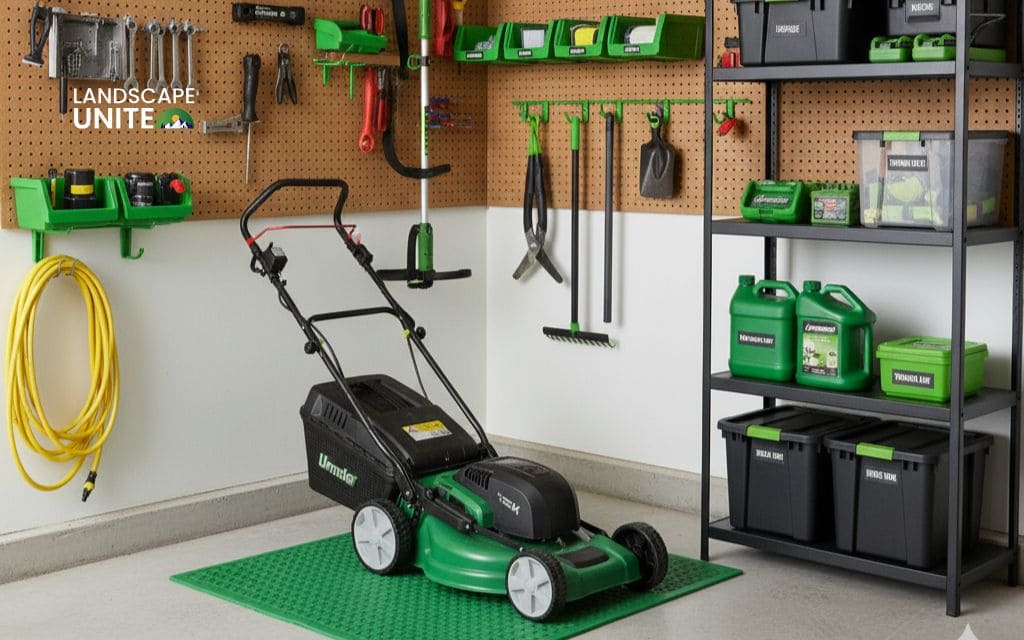
Create a lawn care zone
Dedicated zones transform chaotic garages into organized workshops. Designate 1 corner or wall section for lawn maintenance equipment, tools, and supplies.
Use pegboards or modular shelving systems to define your lawn care zone. Store your mower as the centerpiece, with related items like fuel cans, spare oil, air filters, trimmer line, and hand tools arranged logically around it.
Label shelves and bins clearly, and consider color-coding your lawn care zone to visually distinguish it from other garage areas.
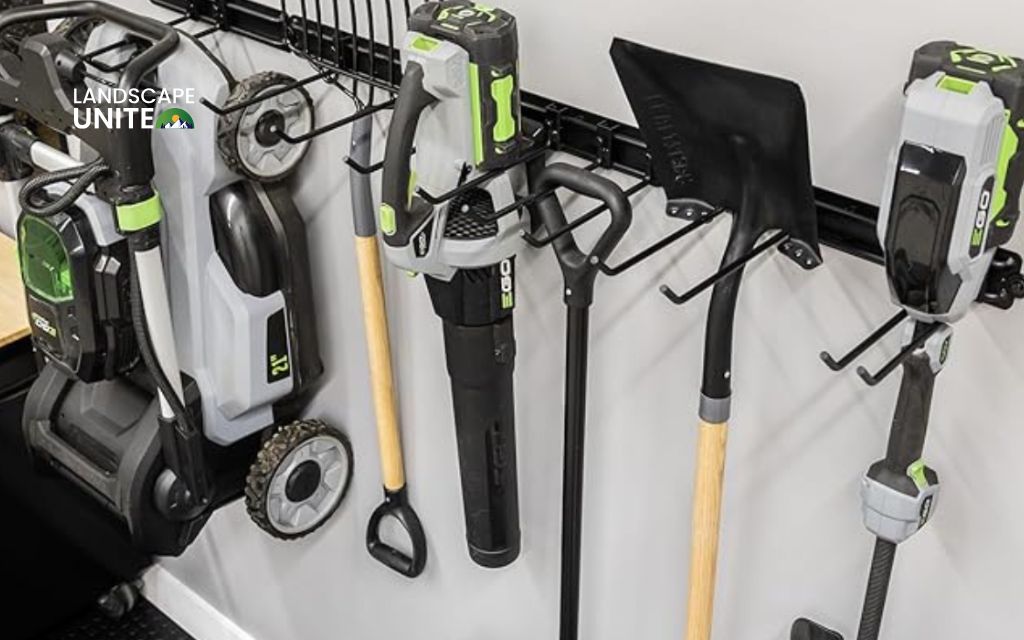
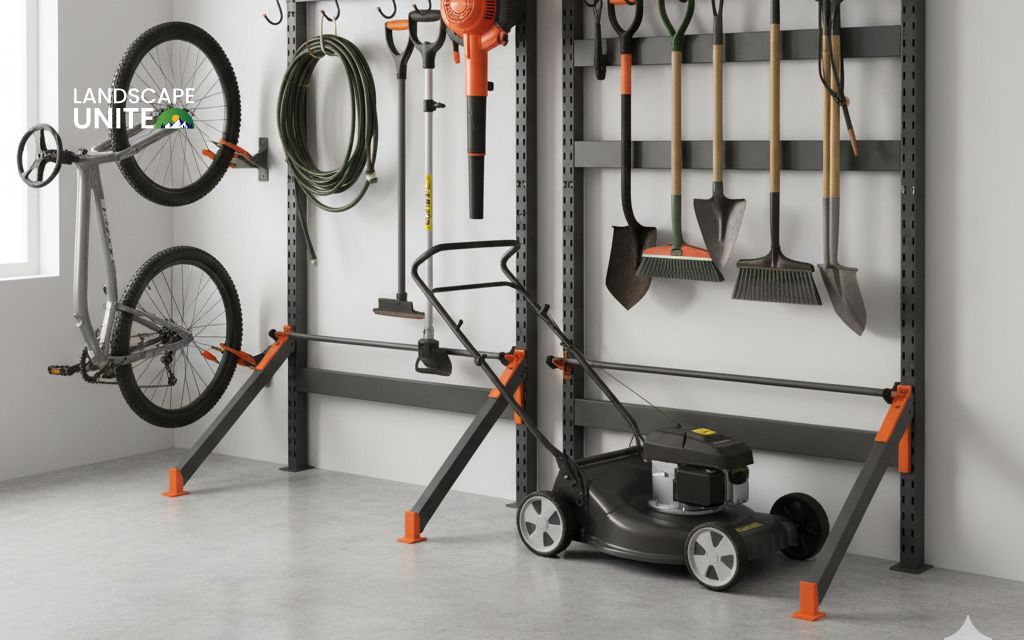
Install vertical bike or tool racks nearby
Maximize vertical wall space by installing multi-purpose racks that accommodate both your mower and related equipment.
Many commercial wall organization systems feature adjustable hooks, brackets, and shelves that you can configure to hold various items. Position your mower storage at the bottom with tool racks above.
Vertical organization keeps everything visible and accessible while consuming minimal floor space. Choose systems with weight ratings appropriate for your heaviest equipment.
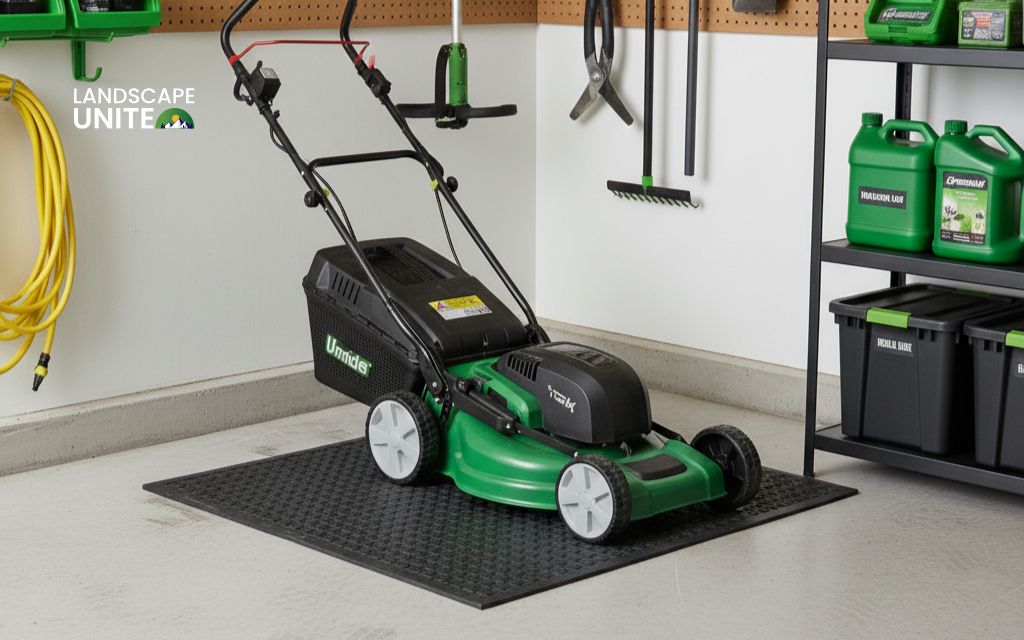
Add a moisture-resistant mat
A simple rubber or vinyl mat creates a protective barrier between your mower and the garage floor. These mats prevent oil drips from staining concrete, catch fuel spills, and reduce moisture transfer from cold concrete to metal components.
Mats also make cleaning easier – simply remove and hose down the mat rather than scrubbing your garage floor.
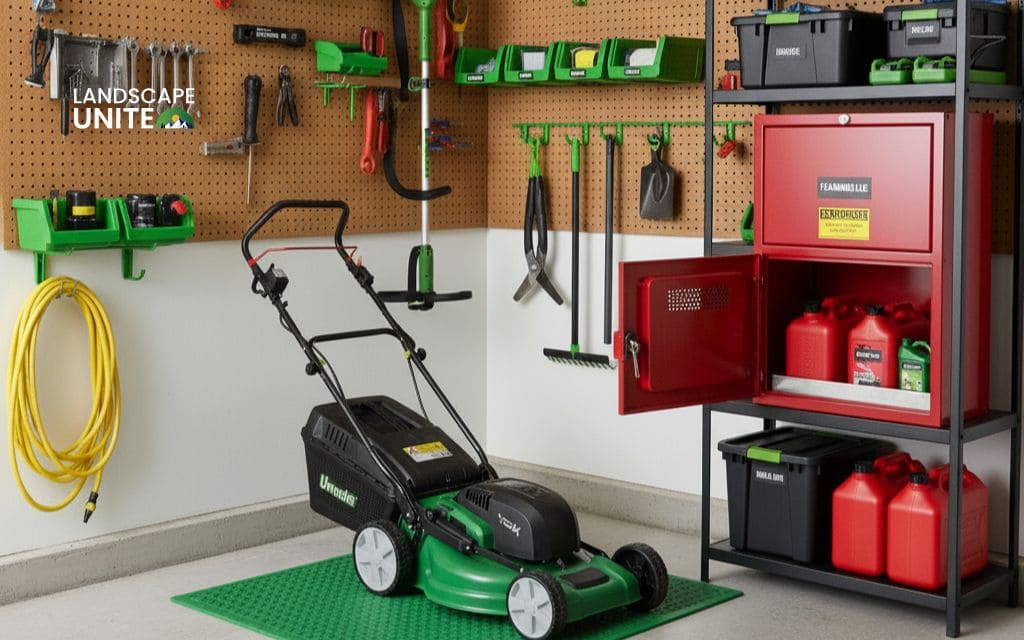
Use fuel storage cabinets
Fireproof metal fuel storage cabinets keep flammable materials secure, contained, and away from heat sources like water heaters or electrical panels. These cabinets are designed with ventilation and spill containment features that standard shelving doesn’t provide.
Store your fuel cabinet near your lawn care zone but never directly adjacent to your mower. Maintain at least 3-5 feet of separation and ensure the cabinet is against an exterior wall if possible.
Always keep fuel containers properly sealed and never store more gasoline than you’ll use in one season. Check your fuel stabilizer annually and dispose of old fuel properly at hazardous waste collection sites.
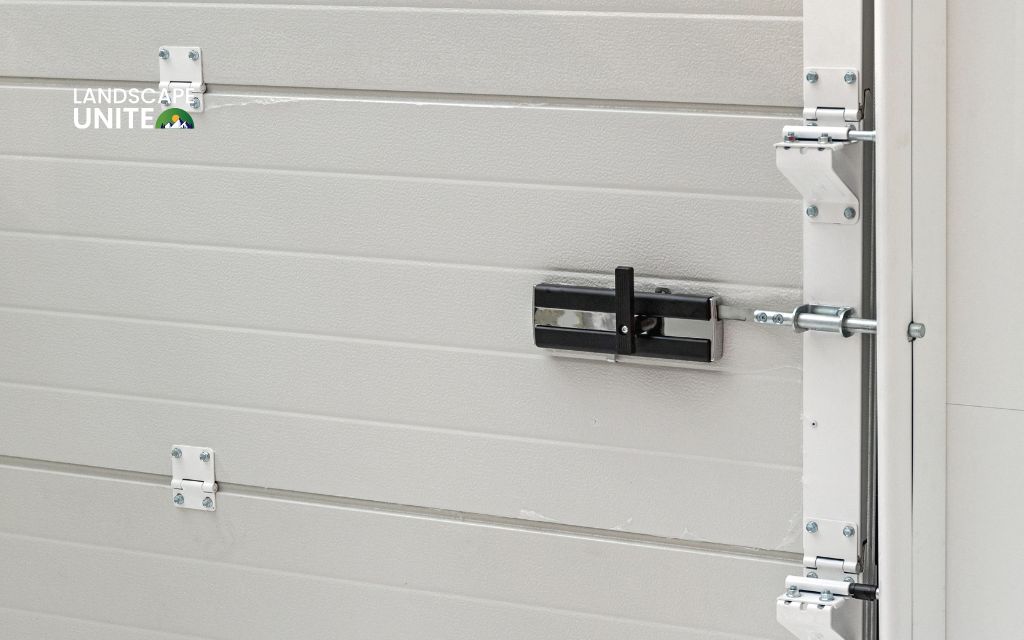
Lock it for safety
If your garage is accessible to neighborhood children, shared with tenants, or opens directly into your home, securing your mower prevents accidents and unauthorized use.
Simple wheel locks or security cables cost less than 20 dollars and provide peace of mind, especially during storage seasons when you’re not regularly checking your equipment.
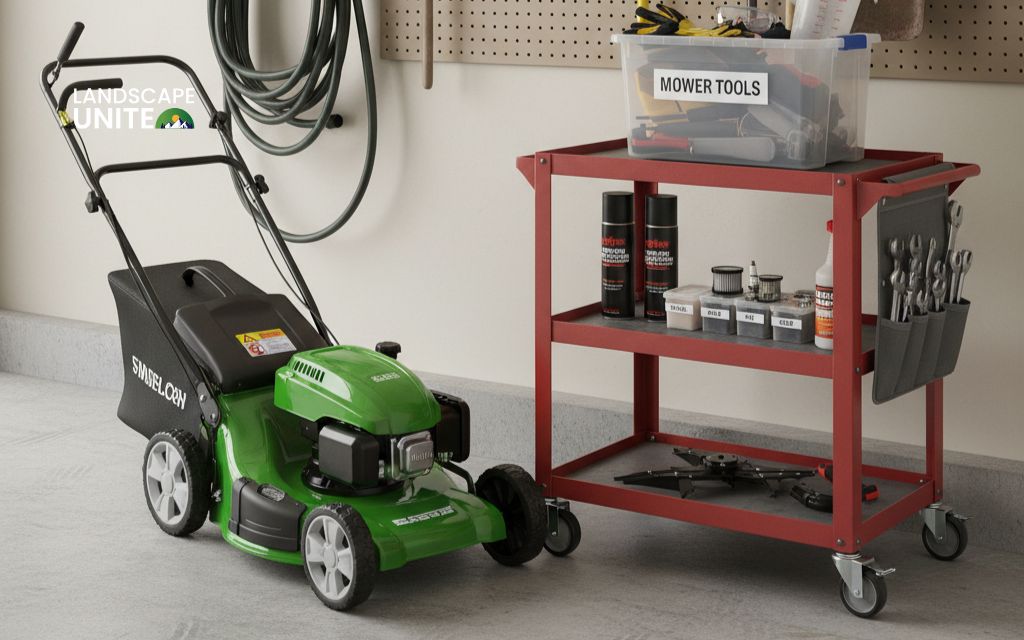
Store lawn mower tools together
Keep all mower-related maintenance tools in a clearly labeled bin or toolbox stored immediately adjacent to your mower. This eliminates frustrating searches when you need to perform routine maintenance.
Consider using a small rolling tool cart or hanging organizer specifically for lawn mower accessories. Include items like work gloves, safety glasses, a blade sharpening file, measuring cup for fuel stabilizer, and spare parts recommended by your manufacturer.
This complete maintenance station means you’ll never postpone important upkeep because you can’t find the right tool.
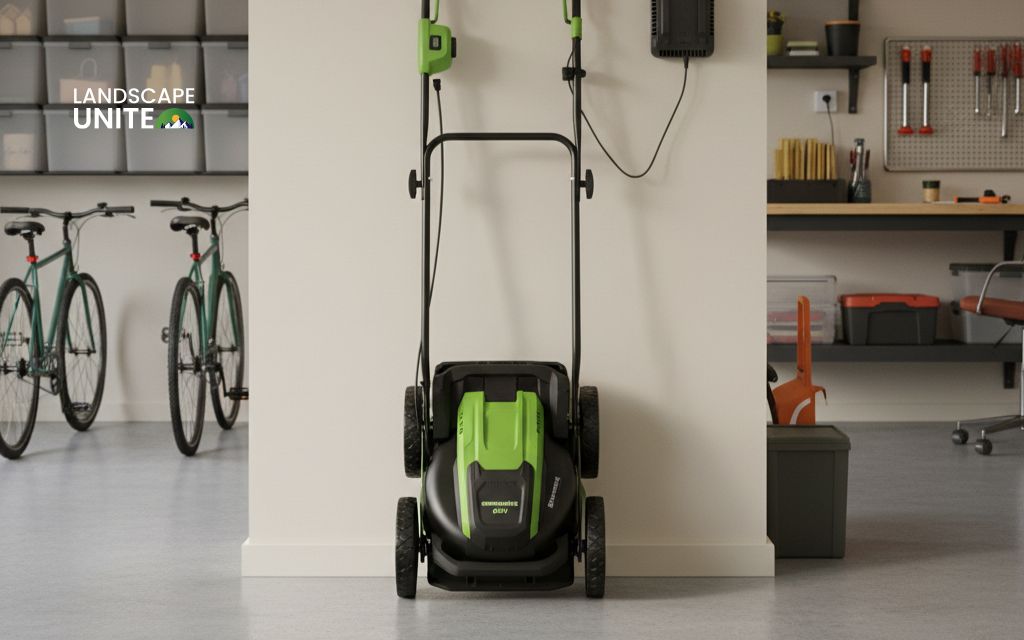
Use a compact foldable lawn mower
If you’re purchasing a new mower and space is your primary concern, modern foldable models from brands like EGO, Ryobi, and Greenworks offer impressive space-saving designs.
These mowers feature handles that fold down and sometimes decks that position vertically, reducing their storage footprint by 50-70%.
Foldable electric mowers are particularly convenient for garage storage, as they eliminate fuel storage concerns entirely. Many models are designed to stand upright against a wall, consuming floor space equivalent to a broom.
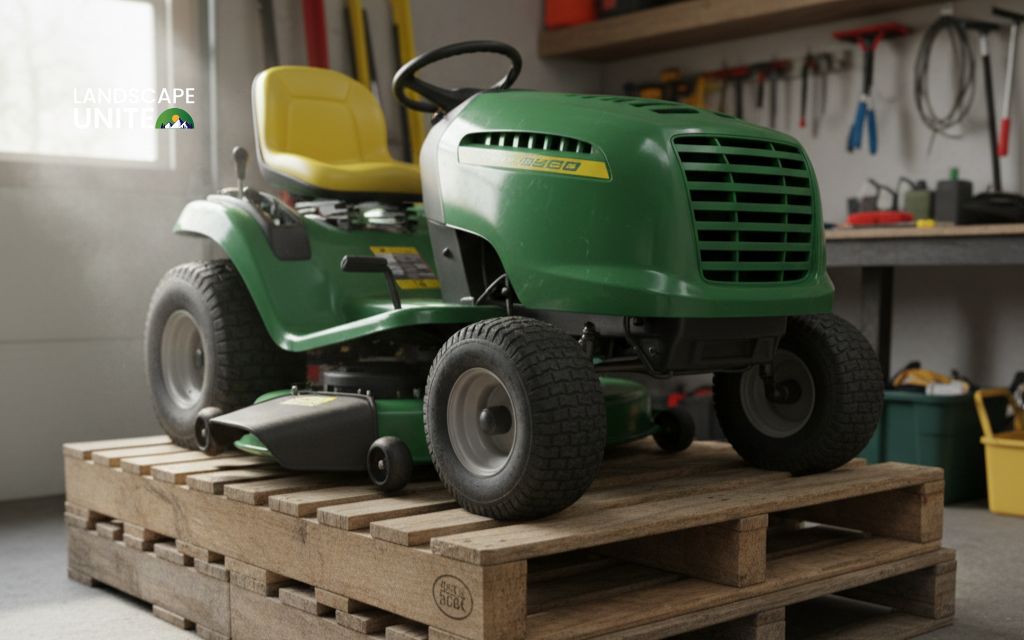
Store on a raised pallet platform
Wooden pallets provide an inexpensive, effective elevation solution that promotes airflow underneath your mower while preventing direct contact with concrete. A standard pallet (48″ x 40″) offers plenty of room for your mower and can be obtained free or inexpensively from many retailers and warehouses.
Mount pegboards for accessories
Pegboards are the ultimate flexible organization solution. Install a 4′ x 4′ or larger pegboard section above or beside your mower storage area to hold all your lawn care accessories.
Use specialized pegboard hooks and holders for various items – baskets for gloves and safety equipment, tool holders for wrenches and screwdrivers, and shelves for bottles and cans.
Paint your pegboard to match your garage aesthetic or use colored tape to outline where each tool belongs, making it immediately obvious when something is missing or hasn’t been returned to its proper place.

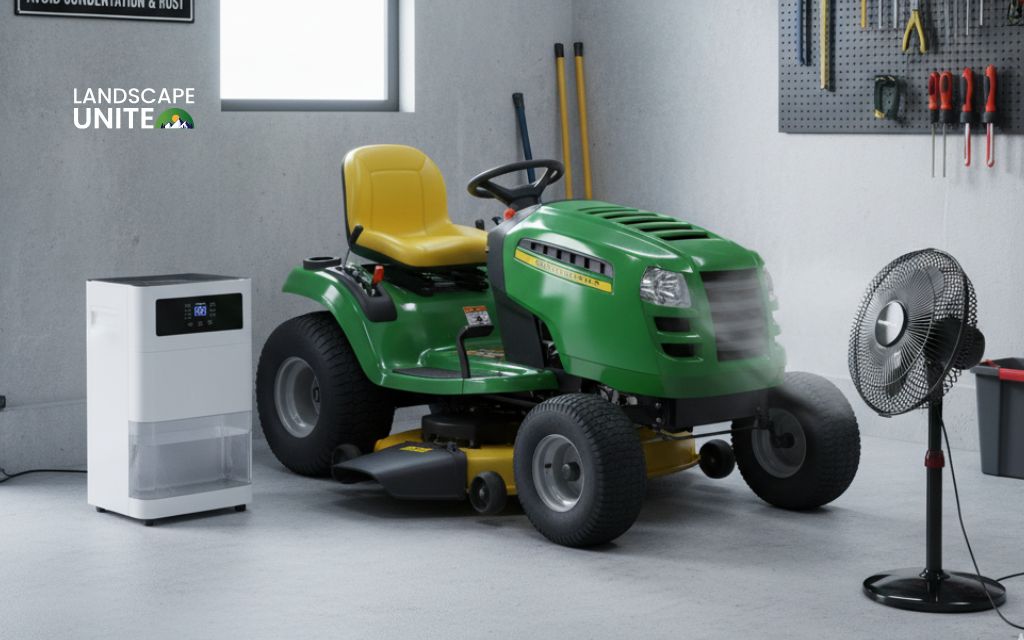
Maintain proper air circulation
Stagnant air promotes condensation, musty odors, and rust development on metal components.
Ensure your mower storage area has adequate air circulation by avoiding completely enclosed spaces unless they’re climate-controlled.
If your garage tends to be humid, consider adding a small fan on a timer or a garage-rated dehumidifier.
Use a garage shed or enclosure
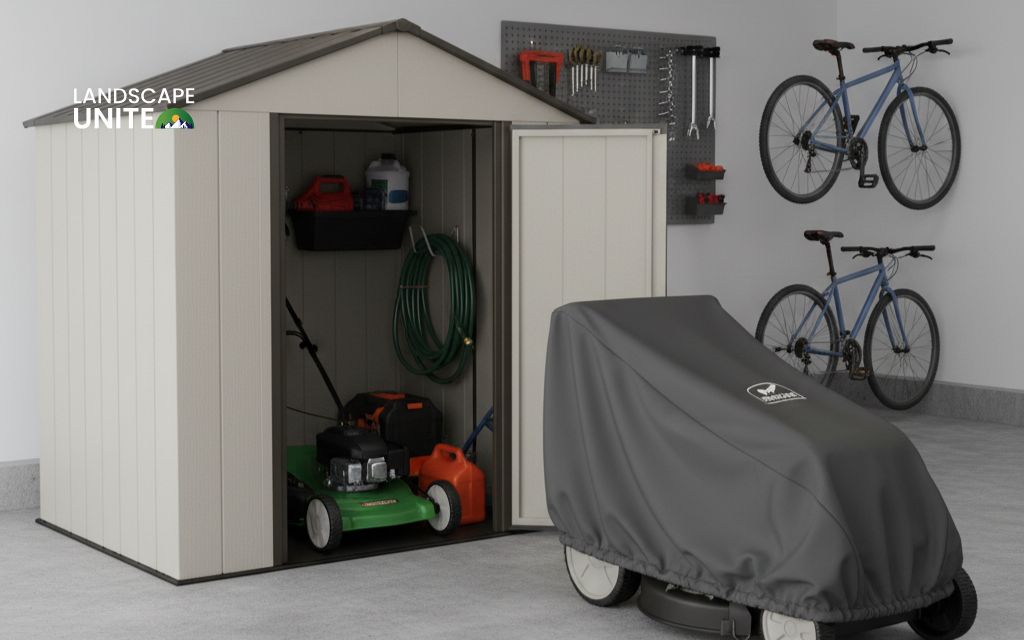
For ultimate protection, especially if storing your mower outside or in a partially exposed area, consider a mini-shed structure inside your garage or a high-quality weatherproof cover.
Small resin sheds (4′ x 6′) fit inside many garages and create a dedicated, protected environment for your mower and lawn equipment.
Avoid plastic tarps, which trap moisture and can do more harm than good. Quality covers feature drawstrings or elastic hems that secure them firmly around your mower, preventing them from slipping off.
How to store a lawn mower for winter
Winter storage requires additional considerations beyond everyday storage practices. Follow these specialized winter storage steps for gas and electric mowers.
Step 1: Empty fuel tank or add stabilizer
For winter storage, fuel management becomes even more critical. Many lawn care professionals recommend running your gas mower completely dry before winter by letting it run until it stalls from fuel depletion. This eliminates the risk of degraded fuel causing starting problems in spring.
If you prefer the stabilizer method, ensure you’re using a winter-grade fuel stabilizer designed to protect fuel for 6-12 months.
After adding stabilizer, run the engine for at least 10 minutes to ensure treated fuel reaches the carburetor and all fuel system components. Top off your fuel tank after treatment (a full tank prevents condensation from forming inside, which can lead to rust in the fuel system).
Step 2: Remove battery (electric models)
Battery care is critical for electric mower longevity, especially during winter months.
Remove your lithium-ion battery completely and bring it indoors to a climate-controlled environment. Extreme cold permanently damages battery cells and reduces capacity.
Check your owner’s manual for specific guidance, as some batteries should be stored fully charged. Set a monthly reminder to check and recharge your battery if necessary.
Step 3: Lubricate moving parts
Winter’s cold, damp conditions accelerate rust formation on exposed metal surfaces. Apply a light coating of machine oil or silicone lubricant to all moving parts including blade pivots, height adjustment mechanisms, wheel axles, cables, and levers. This protective layer prevents moisture from reaching bare metal.
Step 4: Cover the mower
Once your mower is clean, serviced, and positioned in its storage location, protect it with a breathable cover.
Breathability is essential – waterproof covers trap moisture underneath, creating the perfect environment for rust and mildew. Look for covers made from fabric that allows moisture vapor to escape while protecting against dust and debris.
Avoid covering a mower that’s still warm or damp from cleaning. Allow it to dry and cool to ambient temperature before covering. The cover should fit snugly enough not to blow off but loose enough to allow some air circulation.
Step 5: Store away from fertilizers or chemicals
Many homeowners store fertilizers, pesticides, and pool chemicals in their garages, but these substances can be corrosive to metal mower components. Fertilizer vapors, particularly from nitrogen-based products, accelerate rust and corrosion on metal surfaces. Salt-based ice melters are equally damaging.
Position your mower at least 10 feet away from any chemical storage areas. Never store gasoline or fuel containers directly beside fertilizers or oxidizing chemicals – this creates potential fire hazards in addition to corrosion concerns.
Why store a lawn mower in the garage?
Unlike outdoor storage options, garages provide year-round shelter from rain, snow, UV damage, and temperature extremes that can degrade equipment over time.
Security is another significant advantage of garage storage.
Lawn mowers represent valuable targets for theft, and garage storage keeps your equipment out of sight and secured behind locked doors. This protection can also qualify you for insurance discounts on your homeowner’s policy.
Proper garage storage extends equipment lifespan by protecting critical components from weather exposure. Metal parts avoid rust, plastic components resist UV degradation, and engine internals stay dry and clean.
These benefits translate directly into reduced repair costs and longer equipment life.
Safety tips for storing a lawn mower in the garage
Safe storage practices protect both your equipment and your family. Following these essential safety guidelines ensures your garage remains a secure environment for both storage and daily activities.
Avoid fire hazards
Store your mower away from any open flames, heaters, pilot lights, or potential spark sources. Gas-powered mowers can emit fuel vapors even when properly maintained, creating potential fire hazards if stored improperly.
Always allow your mower’s engine to cool completely before bringing it into the garage after use. Hot engines can ignite accumulated debris or fuel vapors, creating dangerous conditions in enclosed spaces.
Prevent accidental starts
Disconnecting the spark plug or removing the battery prevents accidental starting during storage or maintenance activities.
This simple step eliminates the risk of unexpected engine operation that could cause injury or property damage.
Store mowers in locations inaccessible to children and pets. Even with safety precautions in place, keeping equipment away from curious hands and paws provides an additional safety margin.

Check for leaks
Regularly inspect your stored mower for fuel or oil leaks that could create slip hazards or fire risks. Address any leaks immediately, as even small amounts of leaked fuel can create dangerous conditions in enclosed spaces.
Place absorbent mats or cardboard under stored mowers to catch minor drips and protect your garage floor. Replace these protective materials regularly to maintain a clean, safe storage environment.
Delve into best guides for lawn mower:
- Can you jump-start a lawn mower with a car battery? Expert explained
- Can you use car oil in a lawn mower?
- How to make a lawn mower go faster: 6 simple ways to boost cutting speed.
Conclusion
Proper lawn mower storage combines protection, organization, and safety in a system tailored to your specific needs and garage layout.
By following these preparation steps, choosing appropriate storage methods, and maintaining safety practices, you’ll protect your investment while keeping your garage functional and organized.
The storage method you choose should match your mower type, available space, and usage patterns. Whether you opt for simple floor storage or elaborate wall-mounting systems, the key is consistency in preparation and maintenance routines.
Take time to implement these strategies properly, and you’ll enjoy years of reliable mower performance and an organized garage space.
For additional lawn mower maintenance tips and comprehensive guides on garden tools that help maintain your lawn in perfect condition, visit our gardening resource center.
Frequently asked question (FAQs)
Can you hang a lawn mower on the wall?
Yes, lightweight electric mowers and some manufacturer-approved gas models can be wall-mounted using appropriate heavy-duty brackets. Always check your owner’s manual for specific hanging guidelines and weight limits before attempting wall storage.
How do I store a mower for winter?
Winter storage requires thorough cleaning, fuel management (draining or stabilizing), battery removal for electric models, lubrication of moving parts, and protective covering. Complete these steps before extended storage periods to prevent damage.
Is it safe to store a gas mower in the garage?
Yes, gas mowers can be safely stored in garages when fuel is properly managed and the storage location is away from heat sources, open flames, and spark-producing equipment. Proper ventilation and regular leak checks ensure continued safety.
Can I store a lawn mower vertically?
Some mowers allow vertical storage, but this depends on the specific model and manufacturer recommendations. Check with experts before attempting vertical storage, as improper orientation can cause oil leakage and mechanical problems in non-compatible models.